Solar Energy's 2025 Technology Shift: From Perovskite Cells to AI-Managed Grids
DLXN Energy Editorial Team·
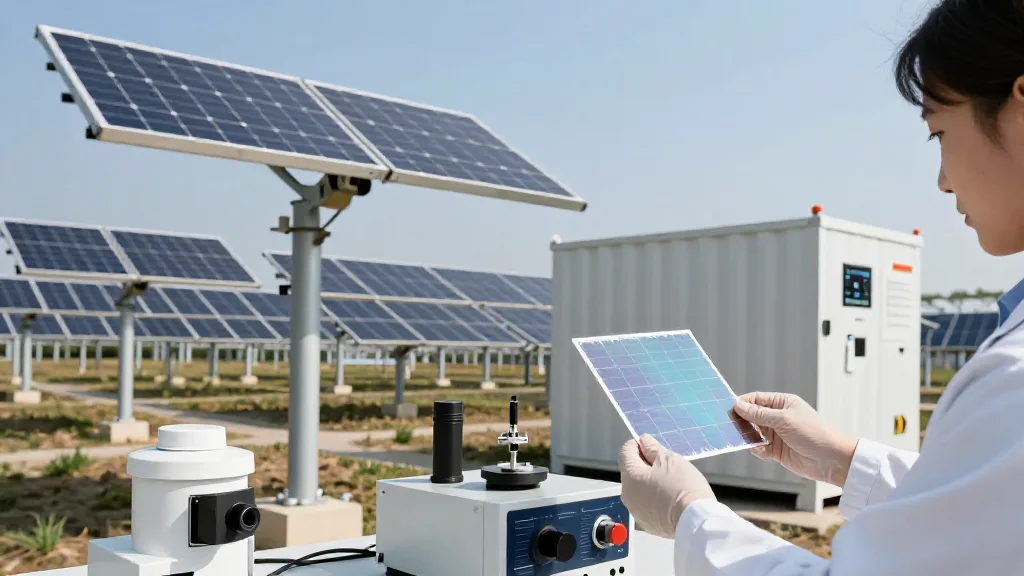
The Efficiency Ceiling Is "https://www.dlxnsolar.com/products"" target="_blank" rel="dofollow">Breaking: Perovskite Tandem Cells Enter Production The most significant technical development of 2025 is not a laboratory curiosity—it is the industrial scale-up of perovskite-silicon tandem cells. According to the [National Renewable Energy Laboratory (NREL), the best research-cell efficiency for a perovskite-silicon tandem now stands at 34.6%, a figure that surpasses the theoretical limit of single-junction silicon cells (approximately 29.4%) by a wide margin. While research records are one thing, commercial reality is another. The International Energy Agency (IEA) reports that commercial tandem modules shipped in early 2025 have stabilized at 28–30% module efficiency—roughly 5–7 percentage points above the best conventional monocrystalline PERC modules. This jump in efficiency is not incremental. For a utility-scale project, a 5% absolute efficiency gain translates to approximately 15–20% lower balance-of-system costs per watt, because fewer modules, racking, and cables are needed for the same output. BloombergNEF (BNEF) estimates that the manufacturing cost for tandem cells has dropped to $0.28/W in 2025, down from $0.45/W in 2023, driven by improved vapor deposition techniques and the use of cheaper hole-transport materials. The key constraint now is not technical viability but production yield—early manufacturing lines report 96–97% yield, which is acceptable but still below the 99% standard for mature silicon production. For system integrators, the practical implication is a shift in design philosophy. Tandem modules operate at higher voltage and lower current, which means string sizing calculations must be redone. The temperature coefficient of perovskite layers is slightly worse than silicon (-0.28%/°C vs -0.34%/°C), so thermal management in hot climates becomes a design consideration. DLXN's solar technology page provides updated string-sizing calculators and thermal derating curves for these new module types. ## 700W+ Modules and the Logistics Rethink The second trend reshaping 2025 is the standardization of 700W+ modules, enabled by larger wafer formats (210mm) and half-cut cell architectures. According to SEIA's 2025 Solar Market Insight Report, modules rated above 700W now account for 38% of all utility-scale shipments in the United States, up from 12% in 2023. The shift has forced a redesign of mounting structures and logistics chains. The weight of these modules (typically 38–40 kg) exceeds the 35 kg ergonomic limit for manual handling in many jurisdictions, which has accelerated the adoption of robotic installation systems. The IEA's Photovoltaic Power Systems Programme (PVPS) reports that robotic installation rates in European utility projects rose from 8% in 2023 to 22% in 2025, reducing installation labor costs by approximately $0.03/W. For asset owners, the larger format also means fewer connections per MW, which statistically reduces the risk of connector failures—a leading cause of performance degradation according to PVEL's 2024 scorecard. However, the 700W+ format creates new constraints for residential and C&I rooftops. The physical size (typically 2.4m × 1.3m) makes handling on pitched roofs more difficult. For these applications, DLXN's residential ESS solutions are designed to pair with modules in the 450–550W range, which remain the sweet spot for distributed generation. The industry is bifurcating: ultra-large formats for ground-mount, and mid-size formats for rooftops. ## AI-Managed Storage and Grid Interactivity
The third pillar of 2025 technology is not a cell or module—it is the software layer that manages the interaction between solar generation, storage, and the grid. The U.S. Energy Information Administration (EIA) reports that 42% of new utility-scale solar projects in 2025 include co-located storage, up from 28% in 2023. This co-location is increasingly managed by AI-based energy management systems (EMS) that perform real-time arbitrage, frequency regulation, and voltage support. The economics are compelling. The International Renewable Energy Agency (IRENA) notes that the levelized cost of solar-plus-storage fell to $48/MWh in 2024 (latest full-year data), a 15% decline from 2023. Much of this decline is attributable to smarter dispatch algorithms that reduce battery cycling degradation. Modern AI EMS platforms can extend lithium battery cycle life by 20–30% by optimizing depth-of-discharge and charge rates based on forecasted weather and grid price signals. For commercial "https://www.dlxnsolar.com/products"" target="_blank" rel="dofollow">and industrial (C&I) facilities, the value proposition has shifted from simple bill savings to grid services revenue. In California's CAISO market, C&I solar-plus-storage systems with AI dispatch earned an average of $67/kW-year in ancillary services revenue during 2024, according to [California ISO data. This revenue stream requires sophisticated forecasting and bidding capabilities that are beyond the scope of traditional energy management. DLXN's C&I energy storage systems now ship with an integrated AI dispatch engine that handles both behind-the-meter optimization and wholesale market participation. The system's machine learning models are trained on three years of historical grid data and update their parameters every 15 minutes. For residential users, DLXN's lithium battery storage includes a simplified version of this AI that prioritizes backup resilience while still capturing time-of-use arbitrage. ## Tracking Systems Get Smarter: The Rise of Sunflower Trackers Fixed-tilt systems remain the default for cost-sensitive projects, but 2025 has seen a significant upgrade in tracking technology. The traditional single-axis tracker follows the sun's azimuth but not its elevation. New "dual-axis with backtracking" systems, such as the DLXN solar sunflower tracker, incorporate wind-speed sensors and real-time irradiance data to optimize the angle for both direct and diffuse radiation. The performance gain is not trivial. According to a 2024 field study published by NREL, advanced dual-axis trackers with backtracking algorithms deliver 18–22% more annual energy than fixed-tilt systems in high-diffuse regions (e.g., the Pacific Northwest), compared to 12–15% for conventional single-axis trackers. The catch is mechanical complexity and maintenance cost. The same NREL study found that dual-axis systems have a 3.2% annual failure rate for actuators, versus 0.8% for single-axis systems. The 2025 resolution to this trade-off is predictive maintenance. IoT sensors on tracker motors transmit vibration and temperature data to cloud-based analytics that predict bearing failure 4–6 weeks in advance. This reduces unplanned downtime by an estimated 70% and brings the levelized cost of dual-axis tracking within 2% of single-axis systems, making the extra energy output financially attractive. DLXN's solar solutions page includes a comparative ROI calculator for fixed vs. single-axis vs. dual-axis configurations based on site-specific irradiance data. ## The Manufacturing Geography Shift
Finally, 2025 marks a notable geographic rebalancing of solar manufacturing. The IEA's Solar PV Manufacturing report indicates that China's share of global polysilicon production fell from 92% in 2023 to 84% in 2025, as new facilities in the United States (under the Inflation Reduction Act) and India (under the PLI scheme) came online. U.S. module manufacturing capacity reached 45 GW by the end of 2024, and is projected to hit 65 GW by the end of 2025—enough to cover roughly 60% of domestic demand. This rebalancing has a direct cost implication. BNEF's 2025 Q1 report shows that U.S.-manufactured modules carry a $0.08–0.12/W premium over imported modules, but this gap is narrowing as domestic supply chains mature. For project developers, the choice between domestic and imported modules now involves not just price but also tax credit eligibility (the ITC bonus for domestic content) and supply security. The 2025 market is not a single global price—it is a patchwork of regional markets with different technology mixes and cost structures. ## Summary of Actionable Takeaways For engineers and asset owners, the 2025 technology landscape offers three concrete opportunities: (1) tandem modules provide a step-change in efficiency that reduces all downstream costs, provided your system design accounts for their electrical characteristics; (2) AI-managed storage has moved from experimental to bankable, with documented revenue streams in organized markets; (3) advanced tracking systems now make economic sense in diffuse-light regions, thanks to predictive maintenance. The industry's challenge is no longer technological feasibility—it is the engineering discipline to integrate these components into reliable, maintainable systems.
Share: