Global PV Market Trends 2025: Efficiency Gains Reshape the Economics of Solar
DLXN Energy Editorial Team·
Green Energy for a Low-carbon Tomorrow
Click to skip
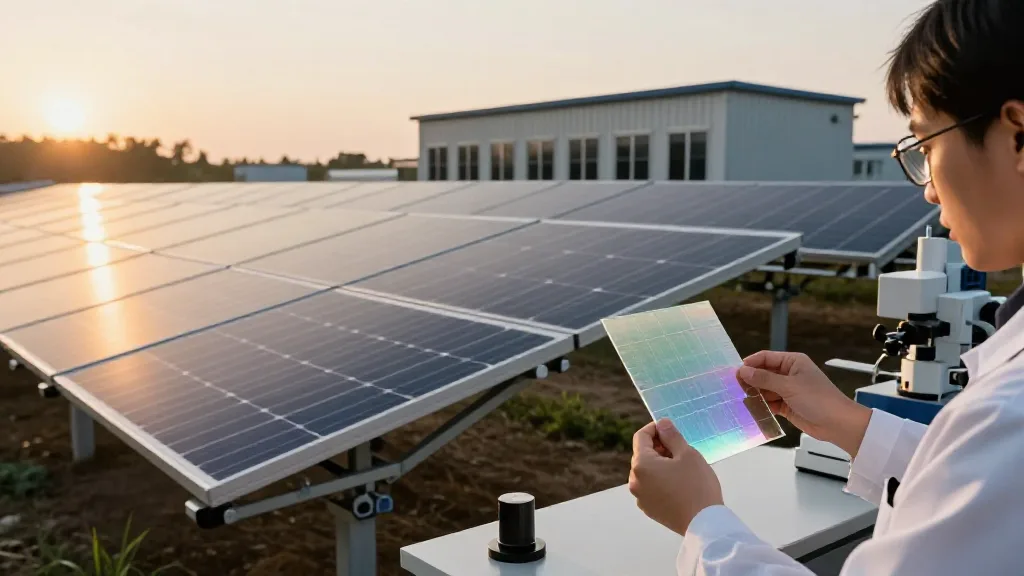
The photovoltaic market has entered a phase that confounds conventional economic models. According to the International Energy Agency's Photovoltaic Power Systems Programme (IEA PVPS), global module prices have fallen by roughly 60% since 2022, with spot prices for mono-PERC modules hovering near $0.10/W in early 2025. Yet installed system costs have not declined proportionally. The National Renewable Energy Laboratory's (NREL) Q4 2024 cost benchmarks show balance-of-system (BoS) components now represent 60–65% of total installed costs for utility-scale projects, up from 45% in 2020.
This inversion has profound implications. While module procurement appears commoditized, the real engineering challenges—and margins—have shifted to inverters, mounting systems, and interconnection infrastructure. The Solar Energy Industries Association (SEIA) reports that U.S. interconnection queue wait times averaged 4.5 years for utility-scale projects in 2024, a 50% increase from 2021. Grid constraints, not panel prices, now dictate project timelines and bankability.
The IEA's Renewables 2024 report projects global PV manufacturing capacity will reach 1.2 TW annually by 2026, with China accounting for 85% of wafer, cell, and module production. This oversupply has driven down prices but also accelerated technology transitions. TOPCon (tunnel oxide passivated contact) cells now represent approximately 65% of new manufacturing capacity, according to BloombergNEF's 2024 PV Market Outlook.
The efficiency gap between commercial and laboratory devices remains instructive. NREL's Best Research-Cell Efficiency Chart shows silicon-perovskite tandem cells achieving 34.6% in laboratory settings—but commercial production of tandem architectures remains nascent, with pilot lines targeting 28–30% module efficiency by 2026.
For procurement managers, the relevant metric is not lab efficiency but energy yield under real conditions. Independent testing from Fraunhofer ISE's CalLab demonstrates that TOPCon modules deliver 3–5% higher annual energy yield compared to PERC counterparts in warm climates, primarily due to lower temperature coefficients (−0.29%/°C versus −0.35%/°C). Over a 25-year system lifetime, this translates to a 2–4% increase in total LCOE-adjusted output—significant for projects financed on thin margins.
DLXN's current production portfolio reflects these trends. Our solar panels lineup now features TOPCon architectures exclusively for utility and commercial segments, with bifacial options delivering up to 12% additional rear-side gain in ground-mounted installations with high albedo surfaces.
The U.S. Energy Information Administration (EIA) reports that 32% of new residential solar installations in 2024 included battery storage, up from 18% in 2022. This trend is driven by net-metering policy rollbacks in key states like California (NEM 3.0) and Hawaii, where export compensation rates dropped by 75% or more. The economics have inverted: self-consumption now drives value, not export.
For the commercial and industrial segment, the value proposition is more nuanced. Demand charge management and resilience requirements—not arbitrage—dominate ROI calculations. BNEF's Energy Storage Outlook projects C&I storage deployments to grow 23-fold by 2030, reaching 58 GW/178 GWh annually. The integration of PV with lithium battery storage systems now routinely achieves 15–20% reductions in facility energy costs when paired with intelligent energy management software.
At utility scale, co-located PV-plus-storage projects represented 38% of new U.S. interconnection requests in 2024, according to Lawrence Berkeley National Laboratory's "Queued Up" report. The pairing addresses the duck curve challenge—California's net load ramp now exceeds 15 GW in spring afternoons, per California ISO data. Storage assets effectively shift 2–4 hours of PV generation to evening peaks, increasing project capacity factors by 15–25%.
DLXN's C&I energy storage solutions are engineered specifically for this co-location scenario, with 2-hour to 6-hour duration configurations and AC-coupled architecture that simplifies retrofits to existing PV fleets.
The Inflation Reduction Act's 45X manufacturing tax credits have catalyzed a domestic production renaissance. SEIA's Solar Market Insight Report documents U.S. module manufacturing capacity reaching 25 GW in Q4 2024, up from 8 GW in 2022. However, cell manufacturing remains the bottleneck—domestic cell capacity is only 4 GW, creating a structural dependency on imported cells that may complicate domestic content qualification requirements for the 10% bonus tax credit.
The U.S. Department of Commerce's anti-dumping and countervailing duty investigations on Southeast Asian imports have created a two-tier market: tariff-affected modules trading at $0.28–0.32/W versus tariff-free products at $0.12–0.15/W. This bifurcation has accelerated procurement shifts toward Mexico, India, and the Middle East as alternative manufacturing hubs.
The U.S. Department of Energy's Solar Energy Technologies Office funds multiple perovskite scale-up projects targeting pilot production by 2026. Key challenges remain: moisture stability, lead containment, and manufacturing yield consistency. For buyers, the practical timeline for commercial perovskite modules remains 2027–2028, with initial deployment concentrated in building-integrated PV (BIPV) and lightweight applications.
Machine learning applications in PV operations are maturing. NREL's Predictive Maintenance research demonstrates that AI-based fault detection can reduce O&M costs by 20–30% and increase annual energy yield by 1–3% through optimized cleaning schedules and early inverter failure prediction. For large portfolios, these gains translate to millions in annual value.
Given the current market dynamics, procurement strategies should emphasize:
1. Technology migration: Prioritize TOPCon or better for new projects; PERC remains viable only for short-term, low-cost applications where efficiency is secondary.
2. Storage pairing: Model all new PV projects with co-located storage, even if deployment is deferred—the interconnection and permitting pathway should accommodate future battery addition.
3. Supply chain diversification: Maintain at least two qualified module suppliers from different manufacturing regions to mitigate trade policy and logistics risks.
4. Performance-based specifications: Move beyond nameplate wattage to specify energy yield guarantees, temperature coefficients, and degradation rates (now commonly 0.4%/year or better).
For residential installations, DLXN's residential ESS systems integrate seamlessly with our high-efficiency panels, achieving round-trip efficiencies above 90% and enabling whole-home backup through intelligent load management. Our solar solutions team provides site-specific yield modeling and storage sizing to optimize self-consumption under evolving net-metering frameworks.
The photovoltaic market's trajectory is clear: efficiency gains, not price reductions, will drive the next phase of cost declines. Each 1% increase in module efficiency reduces BoS costs by approximately 3–4% per watt, according to Fraunhofer ISE's levelized cost of electricity analysis. As TOPCon matures and tandem architectures approach commercialization, the industry is positioned to break the 30% module efficiency barrier within the decade—a milestone that would fundamentally reshape the economics of solar deployment across all market segments.
Latest from DLXN Energy