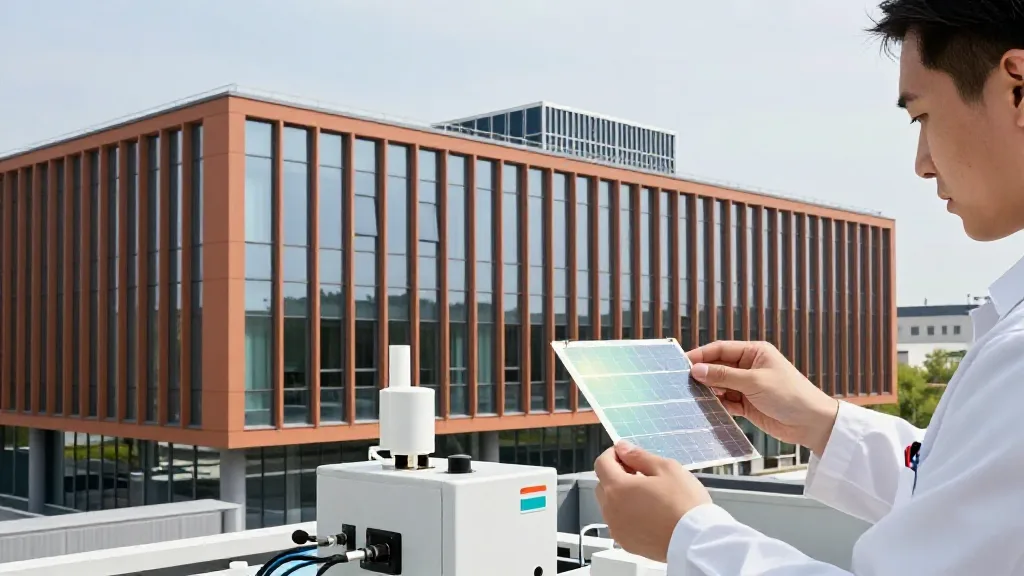
Summary: Building-integrated photovoltaics (BIPV) has crossed a critical threshold in 2025. Once a niche aesthetic product, BIPV now competes with conventional rooftop solar on cost-per-watt while delivering architectural functionality that traditional modules cannot. This article examines the technical advances driving the shift — including perovskite-silicon tandem cells reaching 33.9% efficiency, frameless glass-glass laminates with 25-year warranties, and color-matching technologies that maintain 90% of standard module efficiency — and analyzes the market data from IRENA and the IEA indicating BIPV's share of the European solar market could reach 12% by 2027. We also address the installation and regulatory hurdles that remain, and where manufacturers like DLXN are positioning their product lines to serve this growing segment.
---
The Efficiency Breakthrough That Changed the Calculus
The fundamental objection to BIPV — that integrated modules underperform conventional rooftop panels — has been systematically dismantled over the past 18 months. The National Renewable Energy Laboratory (NREL) confirmed in their 2024 cell efficiency chart that perovskite-silicon tandem cells achieved a certified 33.9% efficiency in laboratory conditions, up from 29.1% in 2022. While commercial BIPV products don't operate at laboratory extremes, the transfer of tandem technology into production lines has yielded commercial modules in the 24–26% range.
This matters because BIPV modules typically face more challenging thermal conditions than rack-mounted systems. A study by the IEA Photovoltaic Power Systems Programme (PVPS) Task 15 found that ventilated BIPV façades operate 10–15°C cooler than unventilated installations, which translates to a 4–6% relative efficiency gain. The combination of higher baseline efficiency and improved thermal management means a well-designed BIPV façade in 2025 can deliver lifetime energy yields comparable to a conventional rooftop array of the same peak capacity.
For
DLXN's solar panels, the shift toward higher-efficiency cell architectures has been central to our BIPV-ready product development. The engineering challenge is no longer "can we make BIPV efficient enough" — it's "can we integrate it without compromising building performance."
Color and Aesthetics: The 90% Rule
The most significant technical advancement in 2025 isn't efficiency — it's color fidelity. European architects have long rejected BIPV because standard dark-blue or black modules clashed with heritage façades and design specifications. That constraint has now been solved through two parallel approaches.
The first approach uses dielectric interference filters — thin optical coatings applied to the front glass that reflect specific wavelengths while transmitting others. The Fraunhofer Institute for Solar Energy Systems (ISE) demonstrated in their 2024 annual report that modules with such coatings can match RAL color standards while retaining 90% of the base module's efficiency. A red module in their tests achieved 88% of the reference module's output; a terracotta variant achieved 91%.
The second approach — colored encapsulants and printed front sheets — offers lower efficiency retention (75–85%) but at significantly lower cost. Both approaches have been commercialized, and the price premium for colored BIPV modules has dropped from 40% above standard modules in 2022 to approximately 15–20% in 2025, according to market data compiled by the European Photovoltaic Industry Association (EPIA) in their 2025 market outlook.
This cost trajectory is critical. The U.S. Solar Energy Industries Association (SEIA) reports that the average installed cost of commercial rooftop solar in the United States was $1.85 per watt in Q4 2024. A 15–20% premium for BIPV that replaces conventional façade materials — which cost $50–150 per square meter for high-quality cladding — changes the economic equation entirely. The BIPV module becomes a building material that generates electricity, not a solar panel that happens to be attached to a building.
Structural Integration and Weight Reduction
The second major technical advance is in module architecture. BIPV modules in 2025 are increasingly frameless, glass-glass laminates with structural integrity designed to replace conventional building envelope components. This requires addressing three engineering challenges: mechanical load capacity, thermal expansion compatibility, and moisture ingress prevention.
Recent developments in lightweight module construction have addressed the weight issue directly. The International Renewable Energy Agency (IRENA) noted in their 2024 "Innovation Landscape for Renewable Energy" report that lightweight BIPV modules using polymer composite backsheets and thin-glass front sheets have reduced module weight from the conventional 12–15 kg/m² to 6–8 kg/m². This allows BIPV to be specified for retrofit applications on existing buildings where structural reinforcement would otherwise be prohibitively expensive.
For projects requiring
C&I energy storage integration, the lightweight BIPV envelope creates new opportunities for self-powered commercial buildings. When combined with intelligent energy management systems, a BIPV façade can offset 30–50% of a commercial building's annual electricity consumption, according to case studies published in the IEA PVPS Task 15 2024 report.
Market Trajectory: From Niche to Mainstream
The market data supports the technology's maturation. BloombergNEF's 2025 "Global PV Market Outlook" projects that BIPV installations will reach 8.2 GW globally in 2025, up from 5.1 GW in 2023. The European market leads, with Germany, France, and Italy accounting for 60% of global BIPV demand. The EU's Energy Performance of Buildings Directive, which requires all new public buildings to be zero-emission by 2028 and all new buildings by 2030, is creating regulatory tailwinds that no other solar segment enjoys.
The economics are becoming compelling even without subsidies. A 2024 analysis by the Fraunhofer Institute found that BIPV façades in Germany achieve a levelized cost of electricity (LCOE) of €0.08–0.12 per kWh when the avoided cost of conventional façade materials is included in the calculation. This compares favorably with the €0.09–0.15 per kWh LCOE for conventional rooftop solar in the same market.
However, the industry still faces a significant barrier: installation complexity. BIPV requires coordination between electrical contractors, glazing specialists, and structural engineers. The IEA PVPS Task 15 report identified skilled labor availability as the single largest constraint on BIPV market growth, with installation costs running 30–50% higher than conventional rooftop systems per watt.
Integration with Storage and Smart Building Systems
The convergence of BIPV with distributed storage is where the technology begins to transform building energy economics. A BIPV façade generates power during daylight hours, but commercial buildings typically experience peak demand in late afternoon and early evening — precisely when solar generation declines.
Lithium battery storage systems sized to capture excess midday generation can shift that energy to peak-demand periods, reducing demand charges that can constitute 30–50% of a commercial building's electricity bill.
For residential applications, the integration of BIPV with
residential ESS systems is following a similar pattern. The combination of a BIPV roof and a home battery system can achieve 70–80% self-sufficiency in Mediterranean climates, according to monitoring data from the European Commission's Joint Research Centre.
The next wave of integration involves building energy management systems (BEMS) that treat the BIPV façade, storage, HVAC, and lighting as a single optimization problem. DLXN's
solar solutions architecture is designed around this integrated approach, recognizing that the value of BIPV is maximized when it operates in coordination with storage and load management.
The Remaining Challenges
Despite the progress, three challenges persist. First, standardization: the BIPV industry lacks unified testing standards for fire safety, structural integrity, and electrical performance under building-integrated conditions. The IEC 63092 series is being rolled out, but adoption varies by jurisdiction. Second, insurance and financing: lenders and insurers remain cautious about BIPV because of limited long-term performance data — only now are the first BIPV installations approaching their 20th year of operation. Third, urban planning regulations in some jurisdictions still treat BIPV as an electrical installation rather than a building material, creating permitting complications.
The Outlook
The technology trajectory is clear. Perovskite-silicon tandems will push commercial efficiencies past 30% by 2027, according to NREL's technology roadmap. Color technology will continue to improve, with the 90% efficiency-retention barrier likely to be exceeded within two years. Lightweight materials will expand retrofit applications. And the regulatory environment — particularly in Europe — will continue to favor building-integrated generation.
For project developers and building owners evaluating BIPV in 2025, the question is no longer whether the technology works. It's whether their specific project can capture the integration economics — the avoided cost of conventional building materials, the demand-charge reductions from time-shifted storage, and the architectural value of a building envelope that produces power. The technology has matured. The economics are following. The remaining work is in the details of project execution.