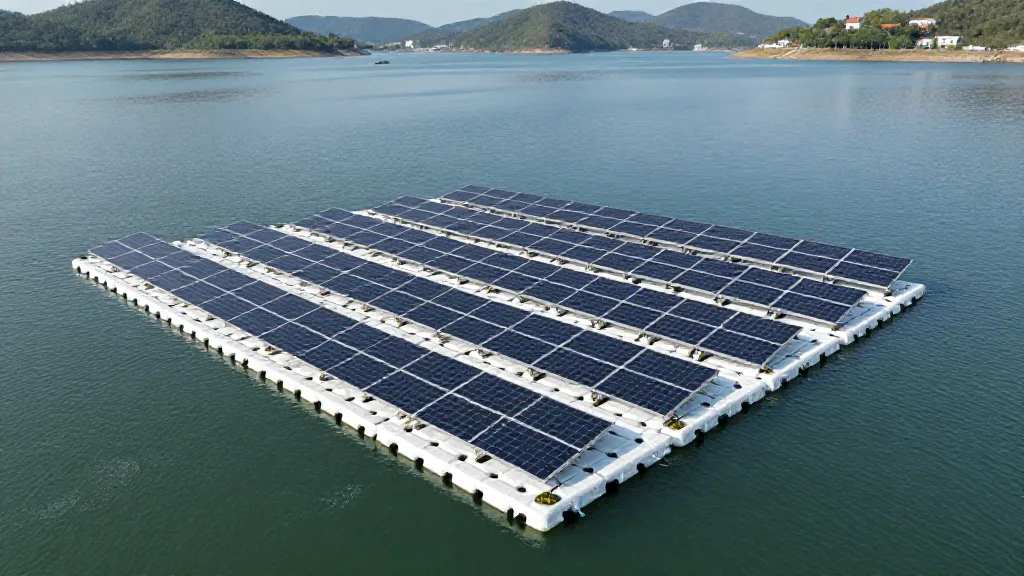
Summary: Floating solar photovoltaic (FPV) systems are transitioning from a niche application to a mainstream deployment strategy, driven by land scarcity and higher energy yields. This article compares the technical performance, capital expenditures, and operational challenges of FPV against traditional ground-mount arrays, citing specific data from the National Renewable Energy Laboratory (NREL), the International Energy Agency (IEA), and the World Bank. While FPV modules operate cooler and produce more electricity per kilowatt-peak (kWp), the balance-of-system costs and anchoring complexities remain significant. The analysis concludes that the optimal approach is not a binary choice but a site-specific hybrid model, where DLXN’s modular solar panels and storage solutions play a pivotal role.
---
The Efficiency Premium: Why Water Boosts Output
Does a solar panel actually perform better when it is floating on a reservoir? According to NREL’s 2023 benchmark report,
Floating Solar Photovoltaic on the Rise, the answer is a qualified yes. The cooling effect of water reduces module operating temperatures by 2–5°C compared to ground-mounted systems in the same climate. Since crystalline silicon modules lose approximately 0.4% of nominal output per degree Celsius above 25°C, this thermal advantage translates into a 3–6% increase in annual energy yield.
The IEA Photovoltaic Power Systems Programme (PVPS) Task 12 report, published in February 2024, confirms these figures, noting that FPV systems in tropical climates—such as those deployed in Indonesia and Vietnam—consistently outperform their land-based counterparts by 4.2% on a per-kWp basis. However, this efficiency gain is not free. The IEA data also indicates that the Levelized Cost of Energy (LCOE) for FPV remains 8–12% higher than ground-mount, primarily due to the cost of floating platforms, mooring systems, and underwater cabling.
For utility-scale developers, the decision is not purely economic. Land acquisition represents 15–20% of total project costs in densely populated regions like Southeast Asia and Western Europe. The World Bank’s 2023
Where Sun Meets Water report estimates that deploying FPV on just 1% of the world’s existing hydroelectric reservoirs could generate 400 GW of capacity—roughly equivalent to the entire current solar fleet of the United States. This is the fundamental driver: FPV is not about beating ground-mount efficiency; it is about unlocking new deployment space.
Cost Breakdown: Where the Money Goes
A granular comparison of capital expenditures (CAPEX) reveals distinct financial profiles. According to BNEF’s
1H 2024 Solar Outlook, the global average CAPEX for fixed-tilt ground-mount systems is $0.82 per watt (W) for projects above 50 MW. In contrast, the same report places FPV CAPEX at $0.95–$1.10 per watt, a premium of 16–34%. This delta is almost entirely attributable to three components:
1.
Floatation Systems: High-density polyethylene (HDPE) floats account for 20–25% of the total FPV CAPEX, or roughly $0.20/W. These components have a design life of 25–30 years, matching module warranties, but they add significant upfront weight and logistics costs.
2.
Mooring and Anchoring: Unlike ground-mount systems that require concrete piers or driven piles, FPV systems must withstand wind-driven waves and fluctuating water levels. The mooring hardware alone adds $0.08–$0.12/W, according to NREL’s technical assessment.
3.
Marine-Grade Electrical Components: Standard PV connectors and inverters are not rated for continuous humidity and potential water ingress. Upgrading to IP67-rated enclosures and specialized cable trays adds 3–5% to the electrical balance-of-system (BOS) costs.
Operational expenditures (OPEX) tell a different story. Ground-mount systems typically require vegetation management—mowing, herbicide application, or grazing contracts—costing $8–$12 per kW annually (SEIA data). FPV systems eliminate this cost entirely. However, they introduce new maintenance requirements: boat access for module cleaning, inspection of mooring lines for biofouling, and potential diver-based anchor inspections. The net OPEX difference is marginal, but the risk profile shifts from land-based issues (weed fires, theft) to water-based issues (corrosion, wave fatigue).
Technical Limitations and Grid Integration
The efficiency gains of FPV are real, but so are its constraints. The primary limitation is site selection. FPV requires a stable water body with minimal current, a depth of at least 2 meters to avoid bottom-scouring during drought, and proximity to existing grid infrastructure. A 2024 study from the National Renewable Energy Laboratory analyzed 2,000 potential reservoir sites in the United States and found that only 12% met all technical criteria, including distance-to-substation limits of 10 kilometers.
Grid integration also differs. Ground-mount systems can be designed with optimal south-facing orientations and tilt angles (typically 20–35 degrees). FPV systems, by necessity, are usually fixed at low tilt angles (10–15 degrees) to minimize wind loading. This reduces the winter production peak, which can create a mismatch with demand profiles in northern latitudes. The IEA PVPS Task 12 report notes that this tilt limitation reduces annual generation by 2–3% compared to an optimally-tilted ground system, partially offsetting the cooling benefit.
However, FPV offers a unique grid service: co-location with hydroelectric plants. When paired with pumped-storage hydro, FPV can reduce reservoir evaporation—a critical benefit in drought-prone regions like the western United States and the Middle East. The California Energy Commission estimates that covering 30% of the state’s irrigation canals with solar panels could save 63 billion gallons of water annually while generating 13 GW of power.
The Hybrid Approach: Combining Land and Water Assets
The industry is moving toward a pragmatic hybrid model. Rather than selecting one technology exclusively, developers are assessing portfolios of sites—including degraded land, agricultural land, and water bodies—and deploying the most appropriate system for each. This is where modularity and supply chain flexibility become decisive.
For land-constrained urban areas, FPV is increasingly paired with wastewater treatment plants and industrial reservoirs. These facilities have existing grid connections, security perimeters, and operational staff, reducing the soft costs that typically plague FPV projects. For rural utility-scale projects, traditional ground-mount remains the cost leader, particularly when combined with
solar solutions that integrate tracking and bifacial technology.
DLXN’s product portfolio is designed for this hybrid reality. Our
solar panels are available in both standard and marine-grade variants, with the latter featuring enhanced corrosion-resistant frames and moisture-sealed junction boxes. For FPV projects, our
lithium battery storage systems provide the fast-responding energy shifting needed to smooth the output variability caused by wave-induced shading. On the residential side,
DLXN residential ESS units can be paired with small-scale FPV systems on ponds or decorative water features, offering homeowners a novel way to generate power without sacrificing yard space.
For commercial and industrial (C&I) clients with large cooling ponds or water treatment facilities, our
C&I energy storage solutions are engineered to integrate with FPV inverters, providing black-start capability and peak shaving in a single package. The key is that the storage system—whether on land or water—must be sized based on the actual production profile of the FPV array, not generic assumptions.
Future Outlook: Scaling the Supply Chain
The floating solar market is growing at a compound annual growth rate of 15.4% (BNEF, 2024). By 2030, the IEA projects cumulative FPV capacity to reach 60 GW, up from 14 GW at the end of 2023. This growth will drive down the cost of floats and mooring systems through economies of scale, but the fundamental physics—cooling benefits versus tilt limitations—will remain unchanged.
The most exciting development is the emergence of hybrid tracking systems. Companies are now testing FPV platforms with single-axis trackers that rotate the entire float island to follow the sun. NREL’s preliminary modeling suggests these systems could achieve a 12–15% yield increase over fixed-tilt FPV, potentially making them cost-competitive with ground-mount tracking systems by 2027.
For developers, the strategic implication is clear: do not standardize on a single mounting technology. Instead, build a portfolio that matches each site’s constraints—land availability, water access, grid proximity, and climate—to the optimal system. This is precisely the approach DLXN advocates through our
solar technology roadmap, which emphasizes modular components that work across both land and water platforms.
The Verdict
Floating solar is not a replacement for traditional ground-mount; it is a complement. Ground-mount systems will continue to dominate in terms of sheer volume and lowest LCOE. FPV will carve out a significant niche in specific geographies—urban areas, reservoir co-locations, and water-stressed regions—where its environmental co-benefits (water conservation, land preservation) justify the cost premium.
The data from NREL, the IEA, and BNEF converge on a single conclusion: the efficiency gap between FPV and ground-mount is narrow (3–6%), but the site-selection criteria are vastly different. Developers who understand both technologies—and who work with manufacturers that offer flexible, durable products for both environments—will be best positioned to capture value in the coming decade.
As the industry matures, the question is not "which technology wins?" but "which technology fits this specific location?" The answer, increasingly, is both.