Solar Carports with Battery Storage: The 2025 Technology Leap

Summary: Solar carports with integrated battery storage have evolved from simple shade structures into sophisticated energy assets in 2025. Advances in high-efficiency bifacial panels, lithium iron phosphate (LFP) batteries, and intelligent energy management systems allow these installations to deliver significant cost savings, grid resilience, and EV charging capabilities. This article explores the key technological breakthroughs driving this market, including vehicle-to-grid integration, AI-driven load forecasting, and modular design, and highlights why they represent a compelling investment for commercial and municipal properties.
The Convergence of Shade, Power, and Storage The modern solar carport
is no longer just a canopy with panels on top. In 2025, the latest systems integrate battery storage directly into the structure, creating a self-contained microgrid. This design solves the two biggest historical challenges of solar power: intermittency and peak demand mismatch. By pairing high-efficiency solar panels with a lithium battery system, these carports can store excess daytime generation and discharge it during evening peak hours, when electricity rates are highest. This "time-shifting" capability can reduce commercial energy bills by 30-50%, depending on local utility tariffs.
Key Technology Breakthroughs in 2025
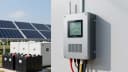
Several specific innovations define this year's carports. First, bifacial PV modules are now standard, capturing reflected light from the ground and car surfaces, boosting energy yield by 5-15% compared to monofacial panels. Second, LFP battery chemistry has become dominant due to its superior thermal stability and 6,000+ cycle life, making it ideal for daily charge/discharge cycles. Third, integrated power electronics now combine inverters, battery management, and EV chargers into a single unit, reducing installation costs and improving efficiency. Our inverter technology page details how these hybrid units manage bidirectional power flow.
AI and Smart Energy Management
The "brain" of the 2025 carport is its energy management system (EMS). Unlike simple timers, modern EMS platforms use machine learning to forecast solar generation, building load, and even EV charging demand. For example, the system can predict a cloudy afternoon and pre-charge the battery in the morning, or delay EV charging to off-peak hours. Some advanced systems, like our Helio2 platform, enable vehicle-to-grid (V2G) functionality, where connected EVs can discharge back into the building or grid during emergencies. This turns the carport into a distributed energy resource, capable of generating revenue through demand response programs.
Modular Design and Aesthetic Integration 2025 has also seen a shift
toward modular, pre-engineered carport structures. Instead of custom steel fabrication, manufacturers now offer standardized bays that can be expanded with additional battery cabinets or EV chargers as needs grow. This modularity reduces installation time from weeks to days and allows for easier maintenance. Aesthetically, designs have become more integrated, with panels mounted flush to the canopy and battery cabinets housed in sleek, weatherproof enclosures. For high-visibility locations, our EOS Carport line offers customizable cladding and lighting options, while the solar sunflower concept demonstrates how parking structures can become architectural landmarks.
Real-World Performance and ROI
Data from 2025 installations shows compelling economics. A typical 500 kW carport system with 1 MWh of battery storage in California or Texas can generate over 700,000 kWh annually. With federal Investment Tax Credits (ITC) and accelerated depreciation, payback periods have dropped to 4-6 years. More importantly, the battery provides backup power during grid outages, a critical feature for businesses with perishable goods or data centers. Many municipalities are also using these carports to meet ambitious EV-ready building codes, which now require a certain percentage of parking spaces to have EV charging infrastructure. You can see examples of our completed projects on our projects page.
The Road Ahead
As battery prices continue to fall—projected to drop below $80/kWh by 2026—and as V2G standards mature, the value proposition for solar carports will only strengthen. They represent a rare investment that combines real estate utilization, renewable generation, energy storage, and EV infrastructure in a single footprint. For property owners looking to future-proof their assets, the 2025 solar carport is not just a trend; it is a foundational piece of the modern energy grid. To discuss a feasibility study for your site, please visit our contact page or learn more about our full product range.