
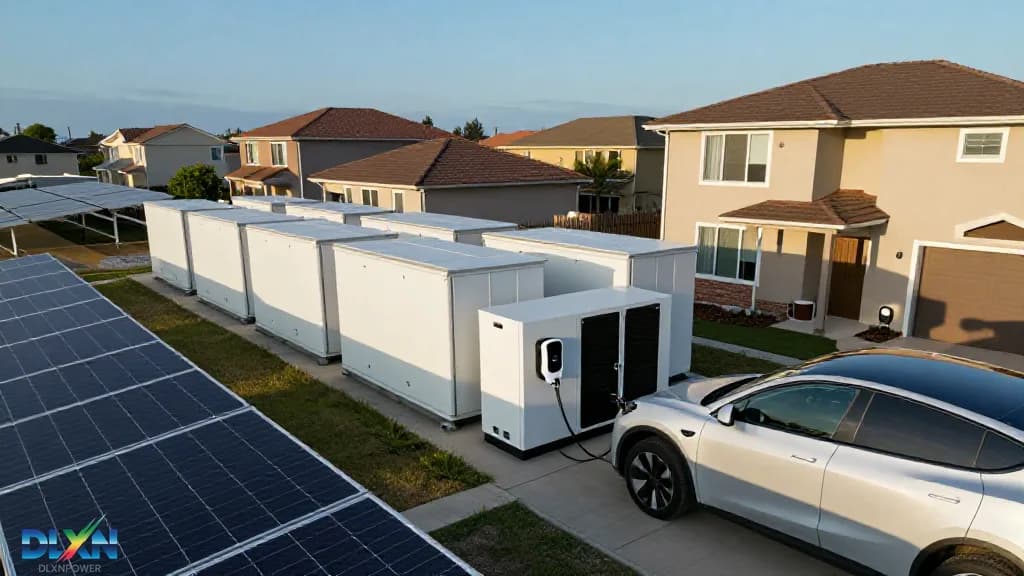
The Surge in Solar-Plus-EV Households The home solar EV charger market is experiencing unprecedented growth, driven by the simple economics of energy arbitrage. In 2024, global EV sales surpassed 17 million units, with nearly 20% of new EV owners in key markets like California and Germany also installing residential solar within the same calendar year. This "solar-plus-EV" is no longer a niche trend but a mainstream purchasing decision. Homeowners are recognizing that pairing a 7-11 kW rooftop array with a Level 2 home charger can offset nearly 60-70% of their annual driving energy needs, translating to savings of $800-$1,200 annually on fuel and electricity costs, depending on regional utility rates. The market for integrated home charging solutions is projected to grow at a compound annual growth rate (CAGR) of 18.4% from 2024 to 2030, reaching a valuation of over $12 billion. This growth is fueled by declining solar panel costs—now averaging $0.25-$0.35 per watt for residential installations—and the increasing efficiency of modern inverters. Furthermore, the rise of smart home energy management systems (HEMS) allows homeowners to automatically schedule EV charging during peak solar production hours, maximizing self-consumption. This shift from grid-dependent charging to solar-driven charging is a fundamental change in consumer behavior, positioning the home as both a power plant and a fueling station.
Bidirectional Charging and the V2H Revolution
Perhaps the most trend in this market is the commercialization of Vehicle-to-Home (V2H) technology. Bidirectional chargers, such as the Ford Charge Station Pro and the Wallbox Quasar 2, now allow EVs to serve as backup batteries for the home. This capability is a for solar homeowners, as it effectively increases their energy storage capacity without the upfront cost of a dedicated home battery. With typical EV battery capacities ranging from 60-100 kWh, a single vehicle can power an average American home for 2-3 days during a grid outage, offering a resilience solution that was previously unattainable. The technical evolution of V2H is accelerating, with the latest chargers supporting bidirectional power flows of up to 11.5 kW, matching the output of most home solar inverters. This allows for off-grid operation during peak demand periods, a practice known as "peak shaving," which can reduce demand charges and time-of-use rates significantly. In Japan and parts of Europe, V2H adoption is already mainstream, with government subsidies covering up to 50% of installation costs. In the U.S., the passage of the Inflation Reduction Act has extended the 30% federal tax credit to include bidirectional charging equipment, a policy move that is expected to drive a 40% annual increase in V2H-capable charger installations through 2027.
The Rise of Integrated Solar Carports
The traditional rooftop solar installation is being complemented, and in some cases replaced, by solar carports as the preferred charging solution for EV owners. These structures, which mount solar panels on a canopy over a driveway or parking area, offer a dual-purpose solution: they generate electricity and provide shelter for the vehicle while it charges. The market for residential solar carports is growing at a CAGR of 22%, outpacing rooftop solar, due to their higher energy yield potential and the convenience of locating generation directly above the charging point. A typical residential carport installation of 6-8 kW can generate 8,000-11,000 kWh annually, enough to cover both home consumption and EV driving needs. This trend is particularly strong in regions with high solar irradiance and limited roof space, such as the Southwestern United States and Southern Europe. Modern carport designs incorporate advanced features like integrated battery storage and smart charging algorithms. For instance, the EOS Carport system integrates high-efficiency panels with a structural design that optimizes airflow for passive cooling, improving panel efficiency by up to 5% compared to roof-mounted systems. Furthermore, carports offer a distinct advantage in terms of scalability, allowing homeowners to expand their solar capacity without the aesthetic or structural constraints of rooftop installations. As EV adoption continues to rise, the carport is becoming the primary interface between home energy production and transportation.
Smart Charging and Grid Interactivity
The modern home solar EV charger is no longer a passive device; it is an intelligent node in a broader energy network. Smart charging technology, enabled by Wi-Fi and cellular connectivity, allows the charger to communicate with the solar inverter and the utility grid in real-time. This enables load management, where the charger automatically adjusts its power output to match solar generation or to avoid peak grid pricing. For example, a homeowner with a 10 kW solar array and a 48-amp charger can program the system to charge the EV only when surplus solar energy is being exported, effectively using the vehicle as a "sponge" for otherwise wasted energy. This grid-interactive capability is being formalized through protocols like Open Charge Point Interface (OCPI) and IEEE 2030.5, which allow for communication between chargers, inverters, and utility demand response programs. In 2024, over 35 utility programs across the U.S. and Europe offered incentives for homeowners to allow their EV chargers to be remotely curtailed during grid stress events. Participation in these programs can yield annual rebates of $100-$300 for homeowners. Additionally, the integration of AI and machine learning algorithms into charging software is enabling predictive charging, which uses historical driving patterns and weather forecasts to charging schedules, further reducing energy costs by up to 25% compared to unmanaged charging.
Battery Storage Integration: The Complete
While V2H technology offers a compelling value proposition, the majority of homeowners still prefer dedicated home battery storage to complement their solar and EV charging setup. The rationale is simple: batteries provide uninterrupted power during outages without depleting the EV's range, and they offer more flexible daily cycling. The cost of lithium-ion battery packs has fallen below $100/kWh at the pack level in 2025, making a 10-15 kWh home battery an affordable addition to a solar-plus-EV system. This has led to the rise of "whole-home energy ecosystems," where solar panels, battery storage, and EV charging are sold as an integrated package by a single installer. The technical integration of these components is key to market growth. Modern hybrid inverters, such as those offered in the Helio2 series, now feature multiple MPPT trackers and a built-in battery port, along with a dedicated EV charger output. This consolidation reduces installation complexity and cost, while improving system efficiency by minimizing DC-AC-DC conversion losses. For instance, a fully integrated system can achieve round-trip efficiency of over 90%, compared to 85% for separate components. This approach is driving a shift in the market, with companies like Tesla, Enphase, and Panasonic now offering complete "solar roof + Powerwall + Wall Connector" packages. This trend is expected to dominate the market, as consumers increasingly value the simplicity of a single point of contact for their entire home energy infrastructure.
Policy, Incentives, and Market Outlook
The trajectory of the home solar EV charger market is inextricably linked to policy and regulatory support. The U.S. Inflation Reduction Act (IRA) of 2022 remains the most significant driver, offering a 30% tax credit for solar and storage, and now extending to EV chargers installed in conjunction with solar, up to $1,000. In Europe, the REPowerEU plan has set ambitious targets for solar and EV adoption, with several member states offering VAT reductions on solar-plus-charger bundles. China continues to lead in manufacturing scale, driving down component costs globally. These policies are not just subsidies; they are catalysts for market maturation, encouraging standardization and interoperability. Looking ahead to 2030, the market is poised for exponential growth. Industry analysts predict that by 2030, over 50% of all new home solar installations will include an EV charger, up from 25% in 2024. The emergence of solid-state batteries, with higher energy density and faster charging capabilities, will further enhance the viability of V2H systems. Additionally, the rollout of Vehicle-to-Grid (V2G) pilots, where EVs can sell power back to the grid during peak times, is expected to provide a new revenue stream for homeowners, potentially reducing the payback period for solar-plus-EV systems to under 5 years. As the grid continues to decarbonize and EV penetration deepens, the home solar EV charger is not merely a trend but a foundational element of the distributed energy future. For homeowners, the decision to adopt this technology is increasingly an economic imperative, a climate action, and a step toward true energy independence.
<!--dlxn-article-->