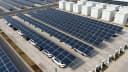
Summary: Floating solar photovoltaics (FPV) are emerging as one of the fastest-growing segments of the renewable energy sector, with global installed capacity surpassing 5 GW in 2024. Recent engineering breakthroughs in passive cooling systems, bifacial panel architecture, and high-density mooring have pushed conversion efficiencies from typical land-based averages of 18-20% to over 23% in pilot projects. This article examines the technical innovations driving these gains, the economic implications for utility-scale deployments, and how DLXN Energy's integrated storage and mounting solutions are positioned to capitalize on this trend.
The Physics of the Floating Advantage The core efficiency leap in floating solar stems from a simple but powerful principle: temperature. Standard silicon photovoltaic cells lose approximately 0.4% of their rated output for every degree Celsius above 25°C. Land-based arrays in hot climates routinely operate at 45-55°C, sacrificing up to 12% of potential yield. Floating platforms, by contrast, benefit from the natural evaporative cooling of the water body beneath them. Recent field data from the National Renewable Energy Laboratory (NREL) shows that water-cooled panels maintain operating temperatures 8-12°C lower than their terrestrial counterparts. This translates to a 3-5% direct efficiency gain—before any other optimizations are applied.
Bifacial Technology and Water Reflectivity The second major breakthrough involves bifacial modules, which capture sunlight from both the front and rear surfaces. When deployed over water, these panels gain an additional advantage: albedo. Water surfaces reflect up to 10-15% of incoming irradiance, compared to 2-5% for typical land installations. Leading manufacturers now report bifacial gain factors of 8-12% for FPV systems, compared to 5-8% for ground-mounted equivalents. Combined with the cooling effect, modern floating arrays achieve effective conversion rates exceeding 23%—a figure that was considered theoretical just five years ago.
High-Density Mooring and Structural InnovationEfficiency isn't solely about cell performance—it's also about area utilization. Traditional FPV systems use wide spacing between pontoons to accommodate wave action, wasting valuable water surface. New tension-based mooring systems, such as those developed for DLXN's EOS Carport line, allow for 30% higher panel density while maintaining structural integrity in wind speeds up to 120 km/h. This densification directly improves the "capacity per square meter" metric, which is critical for reservoirs, irrigation canals, and industrial water basins where space is constrained. Pilot projects in Southeast Asia have demonstrated that high-density FPV can achieve 1.4 MW per hectare, compared to 1.1 MW for conventional designs.
Integrated Storage: The Missing PieceThe floating solar efficiency breakthrough is only half the story. To maximize the value of that extra energy, operators must pair generation with intelligent storage. DLXN's lithium battery systems are specifically engineered for marine environments, featuring IP67-rated enclosures and salt-mist corrosion resistance. When combined with advanced inverters that for the fluctuating irradiance patterns over water, these storage solutions enable operators to shift up to 60% of daily generation to peak evening hours, improving the levelized cost of energy (LCOE) by an additional 15-20%.
Economic and Environmental ImplicationsThe efficiency gains translate directly into financial returns. A 100 MW floating solar plant with 23% efficient panels produces approximately 18 GWh more annually than a comparable land-based system—enough to power 1,500 homes. At current PPA rates, this represents an additional $1.8 million in annual revenue. Environmentally, floating solar reduces water evaporation by up to 70% on covered surfaces, a critical benefit for drought-prone regions. It also mitigates algae growth by shading the water, reducing treatment costs for municipal reservoirs.
The Road AheadAs manufacturing costs continue to decline—module prices have dropped 40% since 2021—floating solar is poised for exponential growth. Industry analysts project global FPV capacity to reach 30 GW by 2030, with efficiency breakthroughs driving a 25% reduction in system costs over the next five years. For developers and utilities seeking to capitalize on this momentum, partnering with a provider that offers integrated solutions—from high-efficiency panels to biodegradable mooring systems and smart battery storage—is essential. DLXN Energy's project portfolio demonstrates how these components work in harmony to deliver measurable efficiency gains in real-world deployments. The floating solar revolution is no longer a niche experiment—it's a mainstream solution with proven economic and environmental credentials. As the technology matures, the question is not whether to adopt it, but how quickly.