BIPV Installation Guide: Engineering Best Practices for Building-Integrated Solar
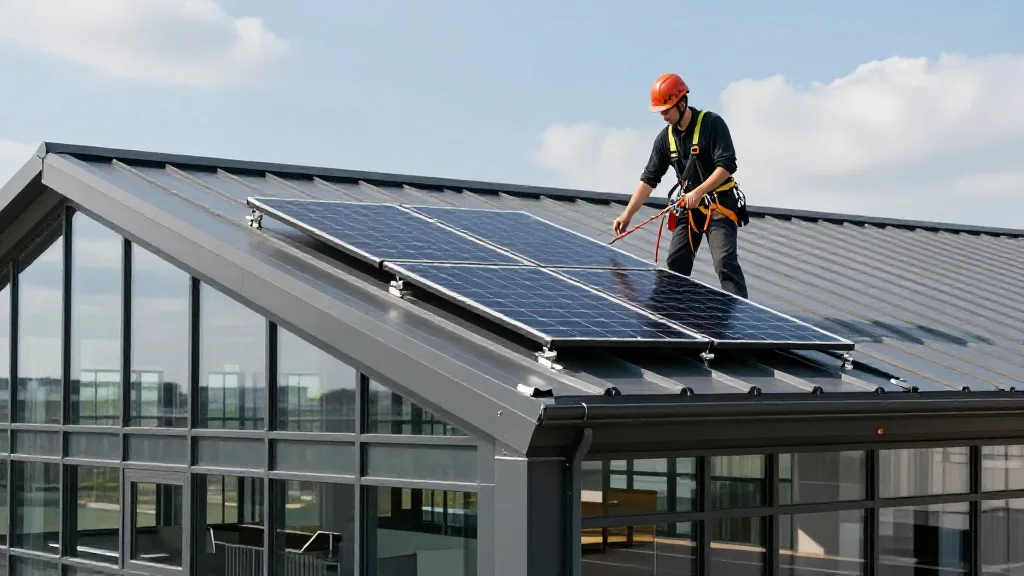
The BIPV Market Context: Why Installation Standards Matter Now
BIPV installations reached approximately 2.3 GW globally in 2023, according to the International Energy Agency, with Europe and China accounting for roughly 70% of deployed capacity. The Solar Energy Industries Association projects U.S. BIPV growth of 12–15% annually through 2030, driven by California's Title 24 requirements and New York's Local Law 97 carbon mandates. Unlike rack-mounted systems, BIPV replaces conventional building materials—roofing tiles, facades, or skylights—so installation errors carry dual consequences: electrical failure and structural envelope compromise.
Pre-Installation Assessment: Load Calculations and Building Orientation
Before any module touches the roof, structural engineers must verify the building can support the added dead load. Standard BIPV roof tiles weigh between 12–18 kg/m², compared to 8–12 kg/m² for conventional clay or concrete tiles, per NREL's BIPV design guidelines. For retrofit projects on buildings constructed before 1980, this difference often necessitates additional roof reinforcement. Wind uplift calculations follow ASCE 7-22 standards, with corner zones requiring fastening densities up to 40% higher than field areas.
Orientation analysis from IRENA's renewable capacity statistics shows that south-facing BIPV facades in the Northern Hemisphere capture 85–90% of optimal annual yield, while east-west orientations still achieve 70–78%. For vertical facades, the optimal tilt is often dictated by architectural sightlines rather than solar geometry—accepting a 10–15% yield penalty is frequently the pragmatic choice for landmark buildings.
Waterproofing Integration: The Critical Interface
The single most common BIPV installation failure is water intrusion at module-to-module and module-to-flashing interfaces. Unlike conventional PV, BIPV modules are the primary weather barrier—there is no secondary roof underneath. Industry best practice, detailed in the NREL BIPV installation guide, mandates:
- Minimum 15 cm overlap between adjacent modules for roof-integrated systems
- Use of EPDM or butyl tape gaskets rated for 25-year UV exposure
- Flashing details that extend at least 10 cm above the module top edge
- Rainwater drainage channels with a minimum 5° slope to prevent ponding
A 2022 study by the Fraunhofer Institute for Solar Energy Systems (ISE) found that installations using integrated gutter profiles reduced water intrusion incidents by 68% compared to field-fabricated flashing. While Fraunhofer ISE is a European source, its methodology aligns with U.S. building codes and has been adopted by major U.S. architectural firms.
Ventilation and Thermal Management: Avoiding Efficiency Derating
BIPV modules run hotter than rack-mounted systems because airflow behind the modules is restricted. NREL field data indicates that roof-integrated modules operate 15–25°C above ambient temperature in summer, reducing efficiency by 8–12% compared to standard rack-mounted systems. For crystalline silicon modules with a temperature coefficient of -0.35%/°C, this translates to a 5–8% annual energy loss.
Mitigation strategies include:
- Ventilation gaps of 5–10 cm behind modules on sloped roofs
- Ridge and eave vents that create natural convection channels
- For flat-roof BIPV, using pedestal mounts that elevate modules 10–15 cm above the membrane
DLXN's Helio2 module incorporates a rear air-channel design that maintains operating temperatures within 10°C of ambient, reducing thermal derating to approximately 4%. This is a meaningful specification for architects comparing BIPV product lines.
Electrical Configuration: DC String Sizing and Microinverter Selection
BIPV systems present unique electrical challenges because module strings are often split across different roof planes or facade orientations. The National Electrical Code (NEC 2023, Article 690) requires rapid shutdown within 30 seconds for roof-mounted systems—a requirement that favors microinverters or power optimizers for BIPV installations.
For a typical residential BIPV system of 6–8 kW, using 400W modules, installers should:
- Limit string lengths to 8–10 modules per string when using string inverters
- Verify maximum system voltage stays below 600V (residential) or 1000V (commercial)
- Use DC arc-fault detection on all roof-integrated circuits
DLXN's lithium battery storage pairs well with BIPV systems for net-zero buildings, offering 95% round-trip efficiency and a 10-year warranty. For commercial projects, the EOS carport system demonstrates how BIPV principles extend beyond the building envelope to parking structures.
Installation Sequence and Quality Control
A disciplined installation sequence prevents costly rework:
1. Dry fit all modules before applying sealants to verify tolerances
2. Install flashing at all roof penetrations (chimneys, vents, skylights) before modules
3. Secure mechanical fasteners to manufacturer torque specifications—over-tightening cracks module frames
4. Wire DC circuits using PV-rated connectors with strain relief
5. Commission with IV curve tracing to verify each module operates within 5% of rated power
Post-installation thermal imaging is non-negotiable. NREL's PV performance monitoring data shows that 23% of BIPV installations have at least one hotspot exceeding 20°C above module average—a precursor to premature failure. Infrared surveys should be conducted within 30 days of installation and annually thereafter.
Economic Considerations: Payback and Incentives
The installed cost of BIPV remains 10–30% higher than conventional rack-mounted PV, but the avoided cost of traditional roofing materials narrows the gap. For a 200 m² roof, replacing asphalt shingles (which cost $8–12/m² installed) with BIPV tiles adds only $15–25/m² in net material cost. The U.S. Department of Energy's Solar Energy Technologies Office reports that BIPV systems achieve simple payback in 8–12 years when displacing premium roofing materials like slate or standing-seam metal.
Federal Investment Tax Credit (ITC) applies at 30% for BIPV through 2032, and several states—including California, Massachusetts, and New York—offer additional incentives for building-integrated systems. For commercial projects, accelerated depreciation under MACRS further reduces effective cost by 20–25%.
Future Outlook: Standardization and Scalability
The BIPV industry is converging on standardized installation guidelines through the International Electrotechnical Commission's IEC 63092 series, which harmonizes testing and installation requirements across Europe, Asia, and North America. As these standards gain adoption, installation costs are projected to decline by 15–20% by 2027, according to BloombergNEF's solar outlook.
For installers and architects, the near-term opportunity is clear: BIPV is no longer a niche product but a viable, code-compliant building material. The key is disciplined adherence to waterproofing details, thermal management, and electrical safety—the engineering fundamentals that separate durable installations from costly failures.
---
Ready to specify BIPV for your next project? Our engineering team provides installation training, structural review, and project-specific layout support. Contact DLXN Solar for a technical consultation, or review our project portfolio to see BIPV installations in residential, commercial, and institutional settings. For a complete building-integrated solution, explore our solar panel product line and inverter technology.